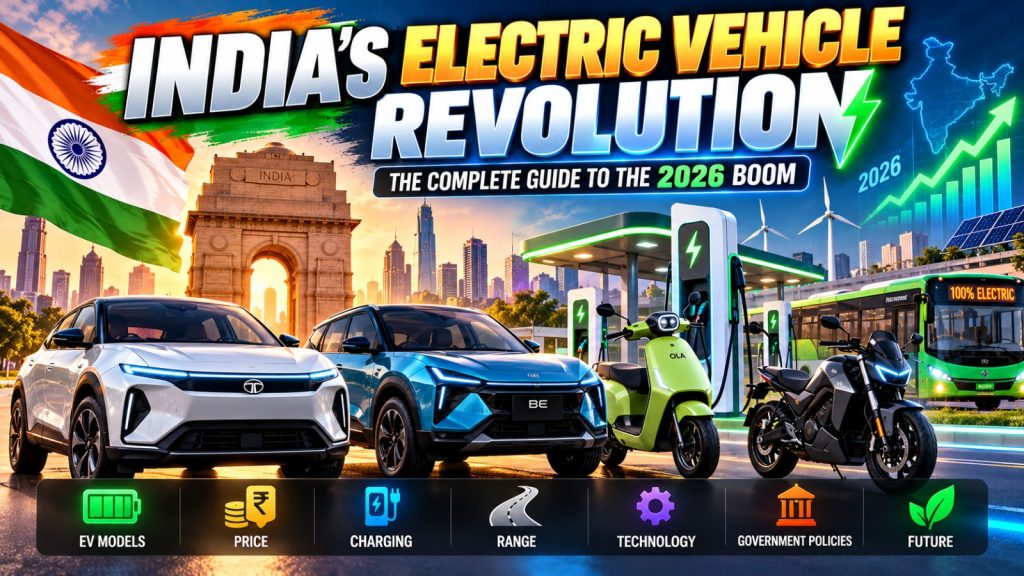
India’s Electric Vehicle Revolution: The Complete Guide to the 2026 Boom
Something remarkable is happening on Indian roads. Electric vehicles, once seen as expensive toys for the wealthy, are now becoming a common sight in cities and towns across the country. From electric scooters zipping through traffic to electric cars quietly cruising on highways, India is experiencing an electric revolution.
In 2026, this revolution reached a major milestone. For the first time, electric vehicles crossed the 10% penetration mark in India’s auto market. This is not a small achievement. It signals a fundamental shift in how Indians think about mobility, energy, and the future.
This guide will explain everything you need to know about India’s EV boom in 2026. We will look at the numbers, the key players, the government policies, the challenges, and what it all means for you as a consumer. By the end, you will understand why this is one of the most important stories in India today.
Part 1: The Numbers That Tell the Story
Let us start with the facts. In September 2026, India’s electric vehicle market recorded its highest-ever monthly retail sales. Total EV sales reached 3,33,634 units, a surge of 74% compared to the same month last year. This was not a one-time spike. It was the culmination of months of steady growth.
The penetration rate, which is the share of EVs in total vehicle sales, expanded to 13% in September 2026, up from 10% a year earlier. This means that for every 100 vehicles sold in India, 13 were electric. Just a few years ago, this number was in single digits.
The growth is happening across all segments. In passenger vehicles, EV penetration rose to 7.9% in September 2026, up from just 4% in FY26. In two-wheelers, which are the backbone of Indian mobility, penetration increased to 11.6%, up from 6.5%. This is significant because two-wheelers account for the majority of vehicles sold in India.
India has also achieved something remarkable on the global stage. For six consecutive months, from April 2026, India’s electric car sales share has been higher than that of the United States. This makes India one of only 15 countries to surpass the US in battery electric vehicle sales share in 2026. For a developing country with a per capita income much lower than the US, this is a stunning achievement.
Part 2: The Companies Leading the Charge
The EV revolution in India is being driven by a mix of homegrown giants and international players.
The Homegrown Heroes
Tata Motors and Mahindra & Mahindra are the undisputed leaders in India’s electric car market. Together, they captured more than 60% of the country’s electric vehicle sales in the first half of 2026. Tata Motors has built a strong portfolio of electric cars, from the affordable Tiago EV to the premium Nexon EV. Mahindra has focused on SUVs, with the XUV400 and the upcoming BE series.
In the two-wheeler segment, TVS Motor and Ather Energy are leading the charge. TVS has leveraged its vast dealership network and manufacturing expertise to scale up electric scooter production. Ather, a startup, has built a reputation for premium electric scooters with smart features and a focus on performance.
The International Players
Tesla finally entered the Indian market and is growing rapidly. In September 2026, Tesla India registered 291 units, a 150.86% increase over August 2026 figures. While this is a small number compared to the mass-market players, it signals that Tesla is serious about India.
JSW MG Motor is another key player. The company has been aggressive with its electric offerings, particularly the Windsor EV, which has gained popularity among fleet operators and individual buyers. A company executive recently stated that EV penetration in passenger vehicles could cross 10% by the end of 2026.
Hyundai and Kia are also making significant investments. Hyundai’s IONIQ 5 and Kia’s EV6 are premium electric cars that compete with global standards. Both companies have announced plans to launch more affordable electric models for the Indian market.
The Luxury Segment
The luxury electric car market is also growing. Sales led by BMW and Mercedes-Benz jumped 61% to a new high of 5,404 EVs in FY2026. This shows that affluent Indian buyers are increasingly choosing electric over petrol or diesel, even at higher price points.
Part 3: What Is Driving This Growth?
Several factors are converging to make electric vehicles more attractive to Indian consumers.
1. Falling Battery Prices
The single biggest factor in making EVs affordable is the falling cost of batteries. Battery packs account for a large portion of an EV’s cost. As battery technology improves and production scales up, prices have come down significantly. This has allowed manufacturers to price their electric models closer to their petrol equivalents.
2. Government Policies and Incentives
The Indian government has been a strong supporter of electric mobility. The FAME (Faster Adoption and Manufacturing of Hybrid and Electric Vehicles) scheme provides subsidies to buyers and funding for charging infrastructure. State governments have also chipped in with their own incentives, including road tax exemptions and registration fee waivers.
The Production Linked Incentive (PLI) scheme for automobiles and auto components is encouraging manufacturers to invest in local production of EVs and their components. This is reducing dependence on imports and creating jobs.
3. Rising Fuel Prices
The global energy crisis and rising fuel prices have made petrol and diesel vehicles more expensive to run. This has pushed many consumers to consider electric alternatives. A company executive noted that “rising fuel prices linked to the global energy crisis have pushed India’s EV adoption above the key 10% penetration threshold”.
4. More Choices for Consumers
Just a few years ago, buying an EV in India meant choosing between a handful of models. Today, there are dozens of options across every price range. From the affordable Tata Tiago EV to the premium Hyundai IONIQ 5, and from practical electric scooters to sporty electric motorcycles, there is an EV for almost every need and budget.
5. Charging Infrastructure Is Improving
One of the biggest concerns for potential EV buyers is charging. Range anxiety, the fear of running out of battery, has been a major barrier. But the charging infrastructure is improving rapidly. India now has thousands of public charging stations, and the number is growing every month. Companies like Tata Power and Ather Grid are setting up fast chargers at strategic locations. Home charging, which is how most EV owners charge their vehicles, is becoming easier with the availability of affordable home chargers.
Part 4: The Cleantech Funding Boom
The EV boom is part of a larger trend: a surge in cleantech funding in India. In the third quarter of 2026, India’s cleantech story accelerated, with investments flowing not just into EVs but also into energy storage, grid technology, and green hydrogen. This shows that investors see electric mobility as part of a broader transition to a cleaner, more sustainable economy.
The funding is coming from both domestic and international sources. Venture capital firms, private equity funds, and development finance institutions are all betting on India’s clean energy future. This inflow of capital is helping startups scale up, manufacturers expand capacity, and infrastructure companies build the charging networks needed to support the EV revolution.
Part 5: The Challenges That Remain
Despite the impressive growth, India’s EV journey is not without obstacles. There are several challenges that need to be addressed.
1. Charging Infrastructure in Smaller Cities
While major metros like Delhi, Mumbai, and Bengaluru have a growing number of charging stations, smaller cities and rural areas lag behind. For EVs to achieve mass adoption, charging infrastructure must be available everywhere. The government and private companies are working on this, but it will take time.
2. High Upfront Cost
Even with falling battery prices and government subsidies, the upfront cost of an electric car is still higher than a comparable petrol car. For many middle-class families, this is a significant barrier. While the total cost of ownership over several years may be lower for an EV, the initial purchase price matters for most buyers.
3. Battery Supply Chain
India is heavily dependent on imports for lithium-ion batteries and their raw materials. This makes the country vulnerable to global supply chain disruptions. The government is encouraging domestic manufacturing of batteries and is exploring partnerships with countries that have lithium reserves. But building a robust domestic supply chain will take years.
4. Grid Capacity
As the number of EVs grows, the demand for electricity will increase. India’s power grid, which already faces challenges during peak hours, will need to be upgraded to handle the additional load. Smart charging solutions, which charge EVs during off-peak hours, can help manage this demand.
5. Resale Value
The resale value of electric vehicles is still uncertain. Unlike petrol cars, which have a well-established second-hand market, EVs are relatively new. Buyers are concerned about battery degradation and the cost of replacement. As the market matures and battery technology improves, this concern should ease.
Part 6: What This Means for You as a Consumer
If you are considering buying a vehicle in 2026, electric is no longer a niche choice. It is a mainstream option. Here are a few things to consider.
Should You Buy an Electric Vehicle?
Buy an EV if:
-
You mostly drive within the city and have a short daily commute.
-
You have a place to charge at home or work.
-
You want to save money on fuel and maintenance.
-
You care about the environment and want to reduce your carbon footprint.
-
You can afford the higher upfront cost or are eligible for subsidies.
Consider a petrol or hybrid vehicle if:
-
You frequently drive long distances in areas with limited charging infrastructure.
-
You cannot charge at home.
-
Your budget is tight and you cannot afford the higher upfront cost of an EV.
Which Type of EV Should You Buy?
For two-wheelers: Electric scooters are ideal for daily commuting. They are affordable, easy to charge, and cost very little to run. The Ather 450X and TVS iQube are excellent choices.
For cars: If you want an affordable electric car, the Tata Tiago EV is a great option. If you want more range and features, consider the Tata Nexon EV or the MG ZS EV. For premium buyers, the Hyundai IONIQ 5 and Kia EV6 are world-class options.
Part 7: The Road Ahead
The future of electric mobility in India looks bright. Experts predict that EV penetration could cross 10% by the end of 2026 and continue to grow rapidly in the coming years. With more models, better infrastructure, and supportive government policies, the transition to electric is accelerating.
India’s success in surpassing the US in electric car sales share is a testament to the potential of emerging markets. It shows that with the right policies, incentives, and entrepreneurial spirit, countries can leapfrog to cleaner technologies.
The EV revolution is not just about cars and scooters. It is about energy security, clean air, and a sustainable future. Every electric vehicle on Indian roads reduces pollution, cuts oil imports, and creates jobs in manufacturing, charging infrastructure, and battery technology.
Final Words: A Revolution You Can Join
The electric vehicle revolution in India is no longer a distant dream. It is happening now. The numbers are clear. The companies are investing. The government is supporting. And consumers are embracing the change.
If you are planning to buy a vehicle, it is worth considering an electric option. It may cost more upfront, but it saves money in the long run. It reduces your dependence on fossil fuels. And it contributes to a cleaner, greener India.
The road ahead is electric. And India is driving on it.